




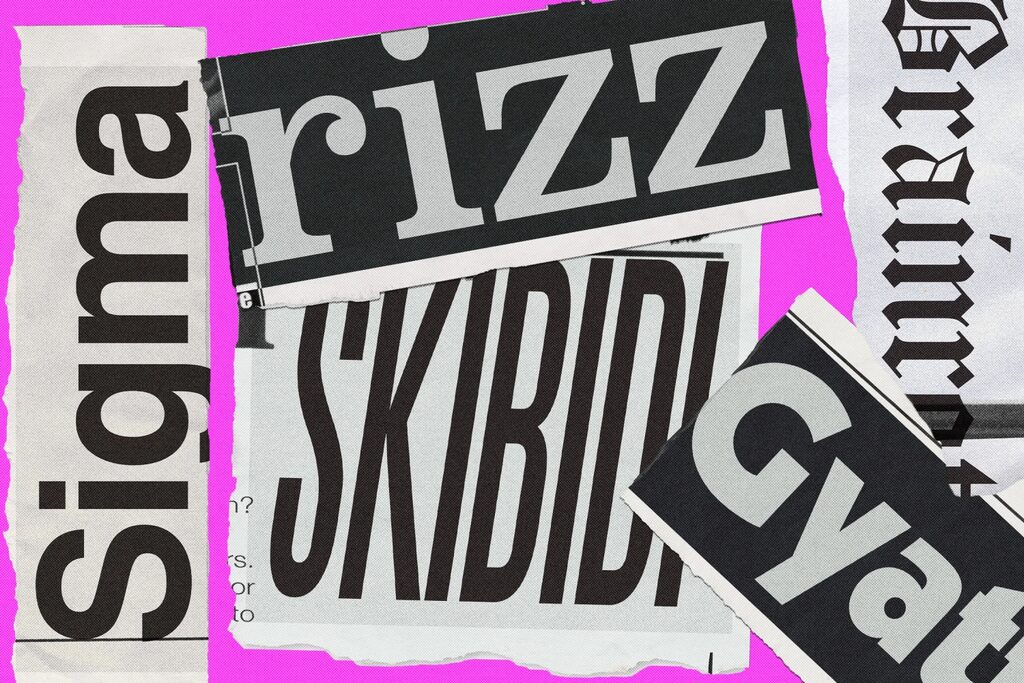
“Skibidi”, “Rizz”, “Gyat”, “Fanum tax”, “Delulu”, “It’s giving…” If you read that list and felt a small wave of confusion, congratulations, you’re exactly who this blog is for. If you understood every word without blinking, you’re probably under twenty. TikTok slang marketing has quietly become a real question business owners have to answer, and here at Ignite Search we get asked about it more than you’d think, usually by someone who’s just watched a competitor caption a post with “no cap” and is wondering if they’re falling behind.
Read on for a straight look at whether that instinct is worth acting on and what to do instead if it isn’t.
Why Everyone’s Suddenly Tempted
The logic makes sense on paper. Younger audiences live on TikTok; TikTok has its own language, so speaking that language should get you closer to those audiences. Add in a bit of pressure from watching competitors do it, and a lot of businesses end up asking their marketing team, or their least amused staff member, to “make it a bit more TikTok.”
The problem is that slang isn’t really a vocabulary list. It’s a social signal, and social signals are brutal about detecting fakes. A word that sounded fresh eighteen months ago can already read as ancient to the exact audience it’s aimed at, and there’s no warning label to tell you which side of that line you’re on.
When It Actually Works
Duolingo is the example everyone points to, for good reason. Its TikTok account, sitting at more than 17 million followers, doesn’t sprinkle slang over otherwise normal marketing. It talks the way an actual person on TikTok talks, jokes the way people on TikTok joke, and treats its own green owl mascot as an unhinged main character rather than a brand mascot reading from a script. Duo has “died” on camera in a fake Cybertruck accident, leaned hard into a running joke about being in love with Dua Lipa, and spent years threatening users who skip their lessons, all in the same chaotic, self-aware tone that was already native to the platform rather than a version dialled down for a brand account.
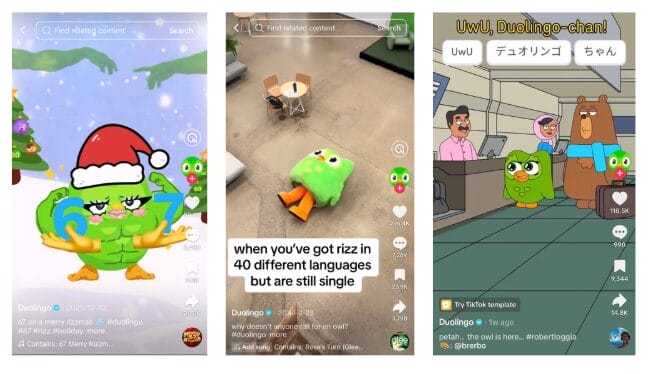
Images via @duolingo on TikTok
The person who ran the account in its early days, Zaria Parvez, has been open about the fact that none of it was random. Every risky post was a calculated one, built by someone who already understood the platform rather than someone translating a marketing brief into it after the fact. That’s the real difference. Duolingo didn’t borrow slang to sound current. It built an account that already belonged inside the culture, and the slang came along naturally because the people running it were already fluent, which is a much harder thing to fake than picking one trending word and hoping it lands the same way.
When It Doesn’t
Even genuinely good, well-resourced brands get the timing wrong sometimes, and it happens to more marketing teams than you’d expect. Irish Spring ran a limited edition bottle built entirely around the word “rizz”, and by the time it launched, the word had already been part of everyday teen vocabulary for a few years. The insight behind the campaign was genuinely sound; people do respond to a brand having a bit of charm, but the specific word it hung the whole idea on had already moved past its moment.
It’s less a story about a brand getting it wrong and more proof of how narrow the window really is, and how easy it is to miss even when the underlying idea holds up.
Or, You Could Just Say You Don’t Know
There’s a quieter approach that gets far less attention than “nail the slang” or “avoid it completely,” and it might be the smartest one for most businesses: admit you don’t get it. The University of Iowa’s admissions marketing team, facing pressure to caption their content with “skibidi Ohio rizz,” decided instead to film their own counsellors looking genuinely baffled by the phrase and post that.
It worked better than forcing the slang ever would have, because it was actually true, and audiences tend to respond well to a bit of honesty when the alternative is guesswork.
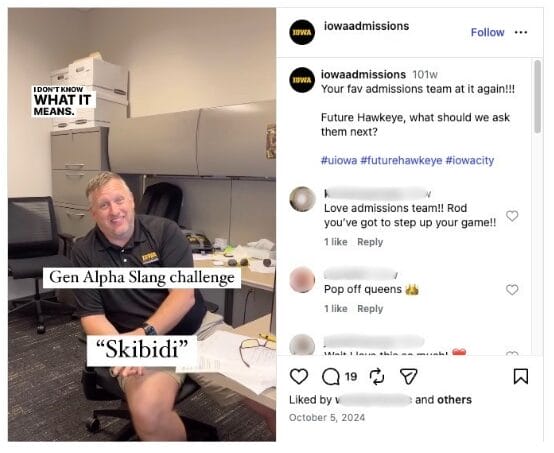
Image via @iowaadmissions on Instagram
What’s Actually Worth Doing
A few honest questions worth asking before any slang goes anywhere near your brand’s caption box:
- Does your actual audience use this term?
- Has the term already peaked? If your teenager rolls their eyes when you say it, that’s your answer.
- Could you say this same thing in your own voice and get a similar laugh, without borrowing someone else’s words?
If the answer to any of those feels shaky, the safer move is usually the university’s approach: be openly, genuinely confused, and let that honesty do the work instead. It’s a strategy that ages a lot better than chasing a word that might not survive the school term.
So What’s the Verdict on TikTok Slang?
None of this means slang is off limits forever. It means the businesses getting real value from it are the ones treating their brand voice as the actual asset, not the slang itself. Get that right first, and the odd bit of internet language slots in naturally instead of sticking out.
We’ve written before about how some brands manage to sneak their way into everyday vocabulary entirely on their own terms, which is really the long game worth aiming for here. If you’d rather figure out what your brand’s actual voice should sound like, slang or no slang, get in touch with Ignite Search.