




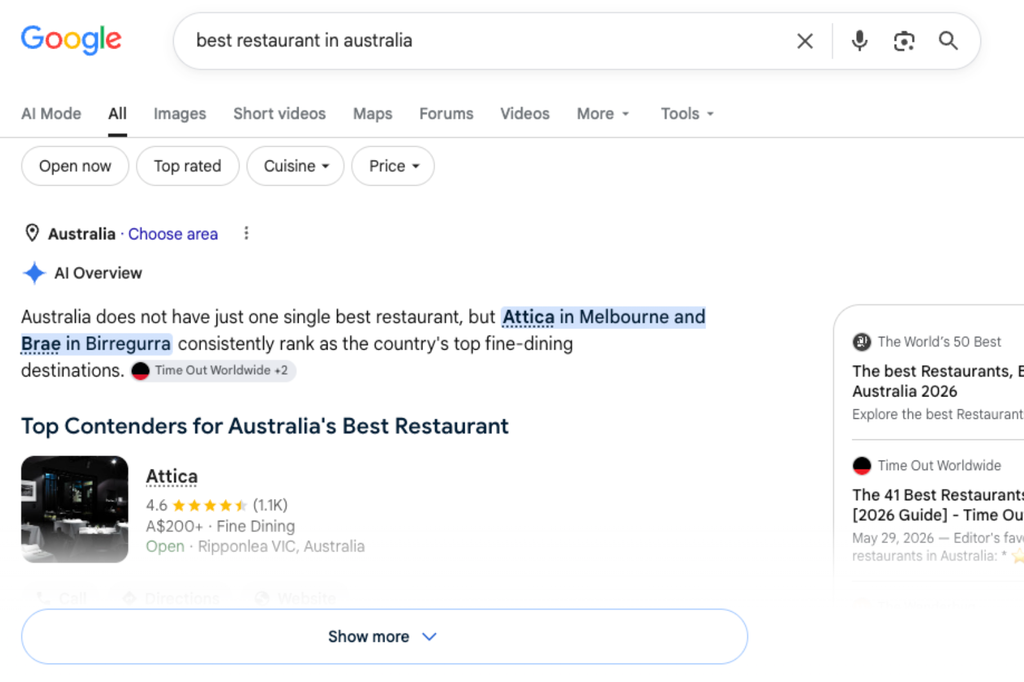
Nearly one in five Google searches now surfaces an AI summary before a single blue link, and most people never scroll past it. So here’s the uncomfortable bit: your website traffic can be sliding month on month with nothing actually wrong, no penalty, no algorithm update, no drop in demand, just a slow bleed on the graph. If you’re only watching Google Analytics, you could easily read that as a problem when it isn’t one. That gap between what’s really happening and what your dashboard shows is a big part of AI search marketing, and it’s exactly the territory Ignite Search has been digging into for this series.
In Part 1, we talked about AI putting together a shortlist before your customer ever lands on your website. This time, we’re picking up on what happens right after that shortlist gets made.
The Click Has Become Optional
For as long as most of us have done digital marketing, traffic was the whole point. More visitors meant more visibility, which meant more customers, simple as that. That chain has quietly come apart.
Pew Research actually tracked people’s real browsing habits, not surveys or actual behaviour, across nearly 900 US adults. When an AI summary showed up on a search results page, only 8% of people bothered clicking through to a link. Without a summary, that number nearly doubled to 15%. And here’s the part that really says it all: barely 1% of people clicked on the sources cited inside the AI summary itself. The AI had already answered the question. Clicking through became something you’d do out of curiosity, not necessity.
Google isn’t the only one doing this either. Ask ChatGPT or Perplexity something and you’ll usually get a full, confident answer with nowhere obvious to click next. If your business got a mention in that answer, brilliant, you did exactly what you needed to do. You just won’t see any trace of it in your analytics.
Traffic Was Never Really the Point
It’s worth remembering what traffic actually stood in for. Nobody genuinely wanted visits for their own sake; what they wanted was awareness, trust, and someone eventually picking up the phone. Traffic was just the easiest of those things to measure, so it became the number everyone tracked.
AI search has quietly broken that shortcut, without handing over anything as neat to replace it. A few ways awareness can now convert into a customer without ever registering as a website visit:
- A recommendation from an AI leads to a direct search for the business name, rather than a click on a link.
- A recommendation from an AI leads straight to a phone call, using the number on a Google Business listing.
- A recommendation builds enough trust that someone simply turns up in person, having never opened the website at all.
None of that shows up as a session, but every bit of it is still a win.

So What Should You Actually Watch?
If traffic alone can’t tell the whole story anymore, a few other signals fill in the gaps. Nothing here is exotic; most businesses already have this data sitting in front of them, it’s just rarely looked at side by side.
- Branded search volume. If more people are typing your actual business name into Google over time, that’s usually downstream of being recommended somewhere you can’t directly see.
- Direct enquiries that mention AI. Ask new enquiries how they heard about you. It’s increasingly common for someone to say an AI tool mentioned you, and that’s worth tracking as its own category, not lumping into “word of mouth”.
- Your own visibility inside AI answers. Periodically asking ChatGPT, Gemini and Claude the exact questions your customers would ask, and noting whether you show up is a genuinely useful habit.
- Phone calls and direction requests from your Google Business Profile. These often hold steady or grow even while website sessions fall, because the AI answer already pointed someone straight to your number or your door.
Put these side by side, and you get a much truer picture than a traffic graph on its own ever could.

But Should You Actually Be Worried?
See, not every traffic drop is secretly good news. If branded search is also sliding, enquiries are drying up, and nobody mentions AI when you ask how they found you, something’s genuinely off and it’s worth digging into properly.
But if traffic’s down while enquiries, phone calls and branded searches are holding steady or even climbing, chances are you’re winning in a way your dashboard was never built to show you.
Telling those two situations apart isn’t always obvious from the outside. If you’re looking at a graph and can’t quite tell which story it’s telling, get in touch with the Ignite Search team and we’ll help you figure out what’s actually happening underneath the numbers.